Sığın
The white doe with golden antlers; she walks ahead of the lost, and is gone on arrival.
- Realm
- Earth
- Type
- Ancestor-Beast
- Might 3/5
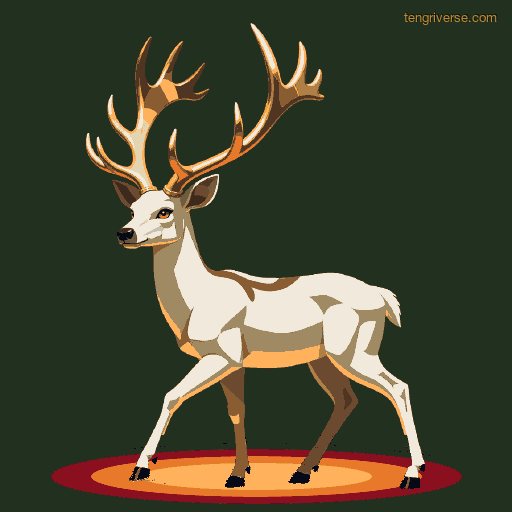 Codex plate · 512×512
In the sourcesfolklore · scholarship · footnoted
Walks ahead, gone on arrival
In Old Turkic sığun is the maral deer; it is the speaker of the sixtieth omen of the Irk Bitig: "I am a nine-… maral deer". Keyik, today's geyik, was at first the name of any wild game animal; buğu and maral come from Mongolian. In the Altai the frame of the Kam's drum is covered with maral skin.[1]
In the sixth century Jordanes writes that a doe appeared unexpectedly before Hun hunters: she entered the Maeotian marsh and showed the way, "now advancing and again standing still"; when the hunters saw the land of Scythia, the doe disappeared. The same doe runs before Hunor and Magor in the Hungarian chronicle.[2]
In the ninth century Duan Chengshi tells of Shemo, ancestor of the Türk: the daughter of the sea spirit sends a white deer each dusk to bring him into the sea. One day a white deer with golden horns will come out of the ancestral cave; if Shemo shoots it the bond will last, if he misses it is cut. Another man kills the deer; Shemo beheads him with his own hand, the bond is cut, and from that day the sacrifice to the standard is taken from that man's tribe. The dynastic annals do not have this legend.[3]
The Secret History of the Mongols opens the line of Chinggis Khan with the blue-grey wolf and his wife Qo'ai Maral, the fallow doe.[4] In 1856 Valikhanov records the mother of the Kyrgyz Bugu: two hunters see, in a herd of marals, a boy with deer's antlers and a beautiful girl; they kill the boy and are cursed. The girl becomes the Horned Mother, ancestress of the tribe and patroness of Lake Issyk-Kul.[5] Ögel's caution stands: no old and original legend says the Turks descend from the deer.[3]
In Tengri Versefictional reading
One person's guide
In Tengri Verse Sığın is the Deer among the Great Guardians (wolf, deer, bear, horse): a Töz, no tribe's. She is a white doe with golden antlers; that the doe is horned is how she is known.
She appears to one who has lost the way. She walks ahead, stops, waits; when the place comes in sight she is no longer there. Kök Böri walks before the whole people; Sığın before one person.
She does not fight. She dies by an arrow like any deer; but the line of whoever kills her is cursed, and the way she opened closes. Nor does she stay dead: she is seen again elsewhere, before someone else. The codex rates her at three: her power is to show the way, and the one who shoots pays for it.
Bibliography
- Clauson, G. An Etymological Dictionary of Pre-Thirteenth-Century Turkish. Oxford, 1972, pp. 755–756, 811–812; Irk Bitig 60; Anokhin, A. V. Materialy po shamanstvu u altaitsev. Leningrad, 1924, p. 54.
- Jordanes, Getica XXIV 123–124 (tr. C. C. Mierow, 1915); Simon of Kéza, Gesta Hungarorum (Endlicher 1849, pp. 86–87).
- Duan Chengshi, Youyang zazu 4; Taiping guangji 480; Ögel, B. Türk Mitolojisi I, TTK, pp. 569–570.
- The Secret History of the Mongols §1 (tr. I. de Rachewiltz); Rashiduddin, Compendium of Chronicles I (tr. W. M. Thackston, 1998), p. 114.
- Valikhanov, Ch. "Zapiski o kirgizakh." 1856; Abramzon, S. M. Kirgizy i ikh etnogeneticheskie i istoriko-kul'turnye svyazi. 1971, pp. 186–189.