Aba
The father whose name is not said; he hears through the earth and finds the oath-breaker.
AgeIV · The Age of Rebirth and the Rise of Erlik
- Realm
- Earth
- Type
- Ancestor-Beast
- Might 4/5
 Codex plate · 512×512
In the sourcesfolklore · scholarship · footnoted
The one who is not named
In Old Turkic the bear is adığ. In the sixth omen of the Irk Bitig a bear and a boar meet on a pass; the bear's belly is slit, the boar's tusk broken: "know this: it is bad". In Kâşgarî's proverb the bear knows as many ways as the hunter knows tricks. Oğuz Kağan has a chest like a bear's, and ties a bear to a tree with his golden belt as bait for the beast. The inscriptions and the Chinese annals' chapters on the Türk have no bear.[1]
Ögel's verdict is plain: the Turks who founded great states have no bear cult. Everything below was recorded between the eighteenth and twentieth centuries among the Altai–Sayan Turks and the Yakut; Dyrenkova, the cult's chief witness, herself writes that there is no convincing proof of it among Turks outside Siberia.[2]
The bear's name is not said. As early as the eleventh century Kâşgarî gives Kıpçak apa for "bear".[1] The Sagai call him aba (father), the Shor apshak (old man) and ulu kiji (great man), the Yakut ese (grandfather); among the Yakut even "grandfather" angers him. For he hears everything through the earth, remembers and does not forgive; yet he does not touch the weak or the one who submits. The hunter does not strike the sleeper in the den but wakes him first: "Get up, old man, the war has come." After the blow he weeps and denies it: the great man fell from a tree, or strangers killed him.[3]
His bones are not broken or burnt; his head is turned east so that he walks west, toward death. The Shor hold "the feast of the great man", the Sagai keen for him as for a human. Skinned, he looks like a person: in the tales the bear is always a human who went into the forest and did not return, and the son born to the woman a bear carried off goes back to the forest in the end. The Altai swear oaths seated on a bearskin, kissing the muzzle; among the Minusinsk Turks the guard of the door is the aba tös, a bear's paw hung at the threshold.[4]
The record places him below, not in the sky: in the Altai creation tales it is Erlik who makes the bear; the bears are the herd of Kayrakan, master of the forest; on the Kam's drum he is painted under the line of the underworld.[5]
In Tengri Versefictional reading
The father who went into the forest
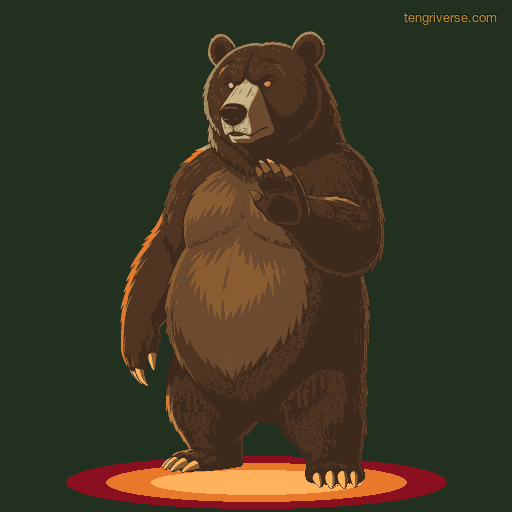
In Tengri Verse Aba is the Bear among the Great Guardians (wolf, deer, bear, horse): a Töz, no tribe's. Aba, "father", is what the people call him; his true name is Adığ, and it is not spoken. He was once a man; he went into the forest and did not come back. That is why he is called father, grandfather, Ulu Kişi, the great man: he is the elder of humankind, the ancestor of no line. In the record Erlik makes the bear; in the universe none of the Guardians is his work.
He hears everything through the earth, remembers, does not forgive; he does not touch the weak or the one who submits. Oaths are sworn on a bear's paw, hide or skull, and he finds the one who breaks them. Every bear Töz a Kam or an Alp draws strength from comes from him.
On the hunt his name is not said and a hidden language is spoken; a sleeping bear is not struck but woken first; whoever strikes denies the blow. Aba can be struck only in his winter sleep, and whoever strikes him asleep is avenged. He cannot touch one who names themself his kin. The codex rates him at four: the strongest body among the Guardians; alone he turns a battle, but he is not measureless like Kök Böri.
Bibliography
- Clauson, G. An Etymological Dictionary of Pre-Thirteenth-Century Turkish. Oxford, 1972, pp. 5, 45–46; Tekin, T. Irk Bitig: The Book of Omens. Wiesbaden, 1993, omen 6; Bang, W. & Rahmeti, G. R. Oğuz Kağan Destanı. İstanbul, 1936.
- Ögel, B. Türk Mitolojisi II, TTK, pp. 329–330, 533; Dyrenkova, N. P. "Bear Worship among Turkish Tribes of Siberia." Proceedings of the 23rd International Congress of Americanists, 1930, pp. 413, 431.
- Dyrenkova 1930, pp. 414–417, 425–427; Seroshevsky, V. L. Yakuty. St. Petersburg, 1896, pp. 658–660.
- Dyrenkova 1930, pp. 419–421, 423–431; Verbitsky, V. I. Altayskie inorodtsy. Moscow, 1893, p. 137.
- Dyrenkova 1930, pp. 429–433; Verbitsky 1893, p. 100; Radloff, W. Proben der Volkslitteratur der türkischen Stämme Süd-Sibiriens I, 1866, pp. 182–183.