Kök Böri
The sky-grey wolf that walks ahead when every tribe is in dire straits.
- Realm
- Earth / Sky
- Type
- Ancestor-Beast
- Might 5/5
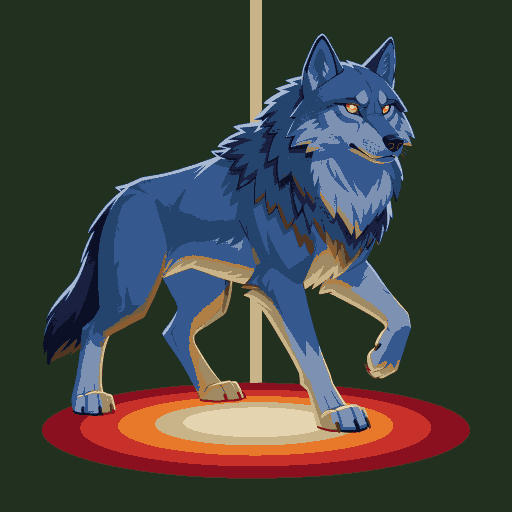 Codex plate · 512×512
In the sourcesfolklore · scholarship · footnoted
Ancestor, then guide
Old Turkic böri is "wolf"; kök is at once "sky", "blue" and "grey". The name carries the colour of the animal and the colour of the Sky together; modern Turkish calls it Bozkurt, the grey wolf. In the Orkhon inscriptions the wolf is the measure of an army: because Tengri gave strength, Bilge Kağan says, his father's soldiers were like wolves and their enemies like sheep.[1]
The Chinese annals of the sixth and seventh centuries trace the Ashina, the ruling clan of the Türk khaganate, to a she-wolf: she nurses a boy, the sole survivor of a massacre, and the line descends from her.[2]
In the Uyghur-script Oğuz Kağan epic a beam of light enters the khagan's tent at dawn, and out of it steps a great male wolf with sky-grey fur and mane. It speaks, and tells him it will walk before his army. The army marches when the wolf marches and halts where it halts.[3]
The wolf is not one people's alone. The Secret History of the Mongols opens the line of Chinggis Khan with Börte Chino, the grey wolf, and Qo'ai Maral, the fallow doe;[4] in the Kyrgyz epic Manas is kök jal, the grey-maned.
In Tengri Universefictional reading
No tribe's wolf
In Tengri Universe every tribe carries a bird of prey as its Ongun, inherited through its lineage. None carries the wolf. Kök Böri is never any tribe's monopoly: it is the over-spirit of the whole people, beyond time and place, the guide and will of Tengri on Earth.
It is a Töz, one of the most ancient root spirits, bound to no single place and no single tribe. It appears when all the tribes are in dire straits.
The codex measures might, not malice. Kök Böri stands at five: not because it threatens the people, but because its power cannot be measured.
Bibliography
- Tekin, T. Orhon Yazıtları. TDK, 1988.
- Sinor, D. "The Legendary Origin of the Türks". Folklorica: Festschrift for Felix J. Oinas, 1982.
- Bang, W. & Rahmeti (Arat), G. R. Oğuz Kağan Destanı. İstanbul, 1936.
- The Secret History of the Mongols, tr. I. de Rachewiltz. Brill, 2004.
- Ögel, B. Türk Mitolojisi I. TTK, 1971.
- Golden, P. B. An Introduction to the History of the Turkic Peoples. Harrassowitz, 1992.