Ügi
The eagle-owl: the one night bird among the six lineage Ongun.
- Realm
- Sky
- Type
- Ancestor-Beast
- Might 1/5
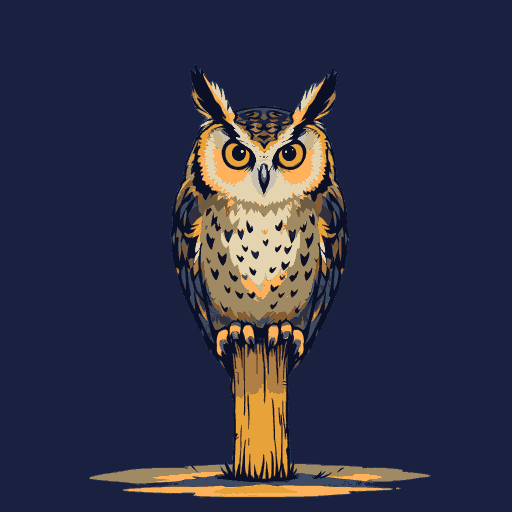 Codex plate · 512×512
In the sourcesfolklore · scholarship · footnoted
A bird that guards, a bird that warns
Ügi is the owl, and on the steppe above all the eagle-owl, the largest raptor of the night. The record on it is thinner than on the wolf or the eagle, and it is split in two.
Among Kazakhs the word lives on as üki, among Kyrgyz as ükü; it names both the bird and the tuft of its feathers worn as a charm. The feathers are fastened to a child's cap and cradle and to the yurt, against the evil eye and harmful spirits.[1]
In Anatolia the owl is the opposite: a bird of ruins whose call announces a death. The record does not reconcile the two; both rest on the same fact, a bird that belongs to the night. The Ongun lists of the Oğuz tribes part ways here: Reşîdüddin gives one bird per lineage, all raptors of the day, while Ebülgazi's list, one bird per tribe, names the ügi as the bird of the Bayat tribe.[2]
In Tengri Versefictional reading
The Sky's bird after dark
In Tengri Verse each of the six lineages carries one bird of prey as its Ongun, and five of them hunt by day. The sixth is Ügi: the eagle-owl, bird of night and sky, Ongun of the Gök Han lineage.
Among the six celestial signs — Sun, Moon, Star, Sky, Mountain, Sea — this lineage is matched with the Sky itself, and its tribes are counted the earthly guardians of their constellations. An Ongun is a tribe's identity, inherited through the lineage.
The codex rates Ügi at one: a protector.
Bibliography
- Köse, S. "Türk Kültüründe Baykuş". Kültür Araştırmaları Dergisi 1/3, 2019.
- Ölmez, Z. "Ebulgazi'ye Göre Oğuz Boylarının Damgaları ve Kuşları". Oğuzlar: Dilleri, Tarihleri ve Kültürleri, Hacettepe, 2015, pp. 729–750.
- Valikhanov, Ch. "Sledy shamanstva u kirgizov". 1860s.