Tulpar
The winged horse born of a mare; the eye that sees its wings kills it.
- Realm
- Sky / Earth
- Type
- Ancestor-Beast
- Might 4/5
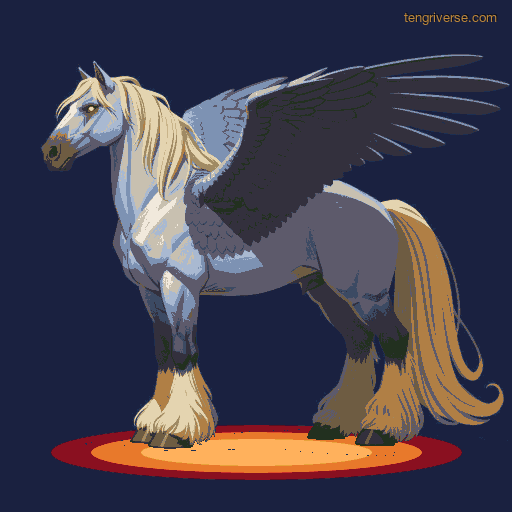 Codex plate · 512×512
In the sourcesfolklore · scholarship · footnoted
Wings on its ribs
Tulpar is the war-horse in Kazakh and Kyrgyz; tolpar in Bashkir and Tatar, tulbar in the southern Altai. The word is absent from pre-thirteenth-century Turkic. Radloff's dictionary gives "war-horse" for Kazakh and Kyrgyz and, for the same word in the Altai dialects, "a poor nag"; the Kyrgyz dictionary's first sense is "myth. winged horse", its last a widow's word for her dead husband, "a hero".[3]
In the Kazakh epic of Koblandy the tulpar is born of an ordinary mare: Kurtka picks the blue-roan mare from the herd, the foal is born and named Burıl. It has "wings on its ribs", "twin wings in its armpits", and runs to war forty-three days short of full growth.[2] The Bashkir legends hold one hard rule: if the wings are seen, the horse dies. In the legend of Turat Sağılı the youth keeps his winged tolpar inside a tent by day, away from people's eyes; where it is seen, it lies down and dies.[1] By the Bashkir encyclopedia the first tulpars came out of the underwater world; their progenitor Akbuzat is the horse whose wingbeats raise a storm when it comes out of the lake.[1]
In the Altai epics the horse speaks, counsels and flies to the sky, but it is not called tulpar.[3] Anatolia has no such word at all; in Dede Korkut, Bamsı Beyrek says to his grey stallion, a sea-foal bought from merchants, "I do not call you horse, I call you brother, better than a brother."[4]
In Tengri Versefictional reading
One rider's horse
In Tengri Verse tulpars are a kind: born of ordinary mares, the wings folded hidden along the ribs. Each tulpar is the personal Töz of one Alp or Kam; whose it is, is known the day it is born, and no one else can ride it. It counsels in its own voice; it carries a Kam to the Sky and back.
Their line goes back to the Horse among the Great Guardians (wolf, deer, bear, horse), the first Tulpar. The codex plate shows that ancestor; where it came from is not told.
Its one weakness is being seen: if a stranger's eye sees its wings, the tulpar dies. So its rider keeps it away from people and flies it where no one is. The codex rates it at four: alone it turns a battle, and a single glance kills it.
Bibliography
- Başqort xalıq ijadı II: Riwäyättär, legendalar. Ufa: Kitap, 1997, pp. 68–71; Bashkirskaya entsiklopediya, "Tulpar", "Konya kul't".
- Qoblandı batır (Kazakh epic), pp. 10–11, 40 of the qazaqepos.com text.
- Radloff, W. Versuch eines Wörterbuches der Türk-Dialecte III, 1905, col. 1475; Yudakhin, K. K. Kirgizsko-russkiy slovar', 1965, "tulpar"; Radloff, W. Proben der Volkslitteratur I, 1866, pp. 63, 327–328.
- Ergin, M. Dede Korkut Kitabı I, p. 136; Gökyay, O. Ş. "Dede Korkut." TDV İslâm Ansiklopedisi 9, 1994.