İe (Yer-Su)
The owner of mountain, water and hearth; on the side of its place.
AgeII · The Golden Age and the Founding of TöreIII · The Dark Age and Isolation
- Realm
- Earth
- Type
- Guardian
- Might 3/5
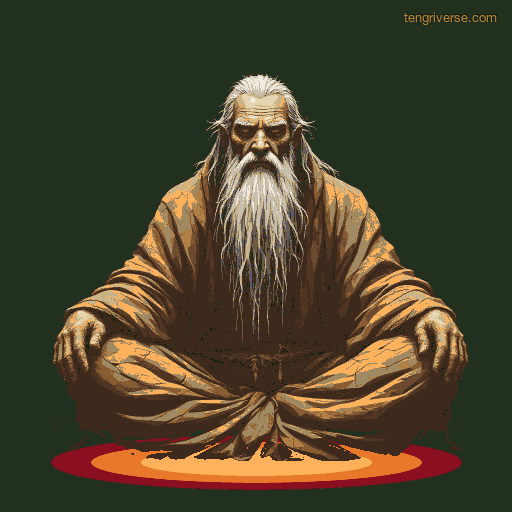 Codex plate · 512×512
In the sourcesfolklore · scholarship · footnoted
Every place has an owner
An İe is the owner of a place or a thing: the spirit of a mountain, a spring, a pass, a forest, a hearth. The word is Old Turkic idi, "owner, master".[5] Together the owners of the land are the Yer-Su, "earth-water", and in the Orkhon inscriptions they stand beside Tengri: "above, the Türk Tengri and the sacred Türk earth-water" set the people in order; in Tonyukuk "Tengri, Umay and the sacred earth-water" press the enemy down.[1]
In the Altai record the owners (eezi) are the spirits closest to people. Everyone offers to them directly: at every dangerous pass the traveller lays a stone on the cairn or ties a rag to the sacred tree; only a Kam can call an owner and compel it to help.[2] A hunter entering the taiga first offers flour to the owner of the mountain and tells tales at night to please it; an offended owner withholds the game, sends the snowstorm, sickens the hunter.[4]
The sources part ways on where the owners come from. In Radloff the Yer-Su are a community of seventeen khans under Ülgen, beneficent to people; in Verbitsky they are Erlik's servants, scattered over forty-three places as they fell, each with the right to kill within its own domain.[2][3]
In Tengri Versefictional reading
On the side of its place
In Tengri Verse every mountain, water and hearth has an İe: the owner of that place, neither good nor evil, on the side of its place. It belongs to no tribe or lineage, and it is not ancient like the Töz; it came into being when the order of the Earth was laid down.
Anyone may offer to an İe and ask its leave and its share; asked, it gives, and if its place is harmed it takes: the game vanishes, the sickness comes. Only a Kam can call it and bind it, and even a Kam asks, never commands. It cannot leave its place; outside it, it is nothing.
The codex rates the İe at three: strong in its own place.
Bibliography
- Tekin, T. Orhon Yazıtları. TDK, 1988.
- Radloff, W. Aus Sibirien II. Leipzig, 1893.
- Verbitsky, V. I. Altayskie inorodtsy. Moscow, 1893.
- Potapov, L. P. "Altay Türklerinde Av Kültü ve Av Ritüelleri" (1929), tr. Bağcı. Karadeniz 15, 2012.
- Clauson, G. An Etymological Dictionary of Pre-Thirteenth-Century Turkish. Oxford, 1972.