Körmös
Erlik's unseen envoy; it stands at the left shoulder and counts.
AgeIII · The Dark Age and Isolation
- Realm
- Underworld / Earth
- Type
- Spirit
- Might 2/5
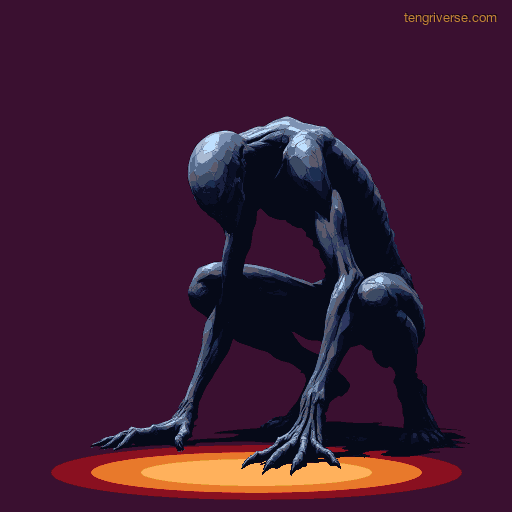 Codex plate · 512×512
In the sourcesfolklore · scholarship · footnoted
The unseen
In the Altai record körmös means "the unseen": the root kör-, to see, with a negative; Radloff glossed it "the invisible one".[1] Anokhin's Altai Kam divide the spirits in four: the aru and kara tös, pure and black, there from the beginning, and the aru and kara neme, pure and black, that came later. The last two, the souls of dead shamans and ancestors, are called by the common name körmös; the word also covers the black tös, Erlik among them.[1]
It has two faces. The aru körmös guard the yurt, clothe the Kam like an invisible armour (kurçu) and fight the evil spirits. The evil körmös are Erlik's army: "Greedy Erlik sends evil körmös to earth for the soul. But they often devour a person." The death-spirit aldaçı is one of these evil körmös.[1] Wounds are the bites of the körmös, and no one sleeps at dusk, lest a körmös steal the soul.[4]
In Radloff, Erlik, who knows of a birth, at once sends a Körmös; it stands at the person's left shoulder, records every evil deed, and at death carries the soul before Erlik's judgement seat.[3] In Verbitsky, Erlik makes himself servants at the anvil: with hammer, bellows and tongs, "at every stroke a kürümes leaps out".[2]
In Tengri Versefictional reading
Sent, never on its own
In Tengri Verse a Körmös is a servant of Erlik Han and nothing else. The record's pure körmös, the dead shamans who clothe the Kam, are in this universe the Töz a Kam is bound to; the name Körmös is kept for Erlik's army alone.
Erlik makes them at his anvil, and what he hammers is the souls of the wicked dead that fall to him: the forge and the fallen soul are one story. Until the fourth age they are his shadow reaching up to the Earth; Aldacı, the Red Bird, is the chief of them.
A Körmös is sent; it never comes on its own. It stands at the left shoulder and counts; it bites in the dark; it steals the soul of one who sleeps at dusk. Alone it sickens one person, and it cannot stand against a Kam. It cannot pass the guard of a Töz a Kam has bound, and it cannot enter the light of a burning hearth. The codex rates it at two.
Bibliography
- Anokhin, A. V. Materialy po shamanstvu u altaitsev. Leningrad, 1924 (pp. 1, 6, 21, 27, 29).
- Verbitsky, V. I. Altayskie inorodtsy. Moscow, 1893 (p. 99).
- Radloff, W. Aus Sibirien II. Leipzig, 1893 (pp. 11–12).
- Küçük, M. A. "Geleneksel Türk Dinî İnanışlarından Mitolojiye: 'Ölüm/Obur Ruhlar'." Gazi Türkiyat 20, 2017.